
By Aubrey Henson
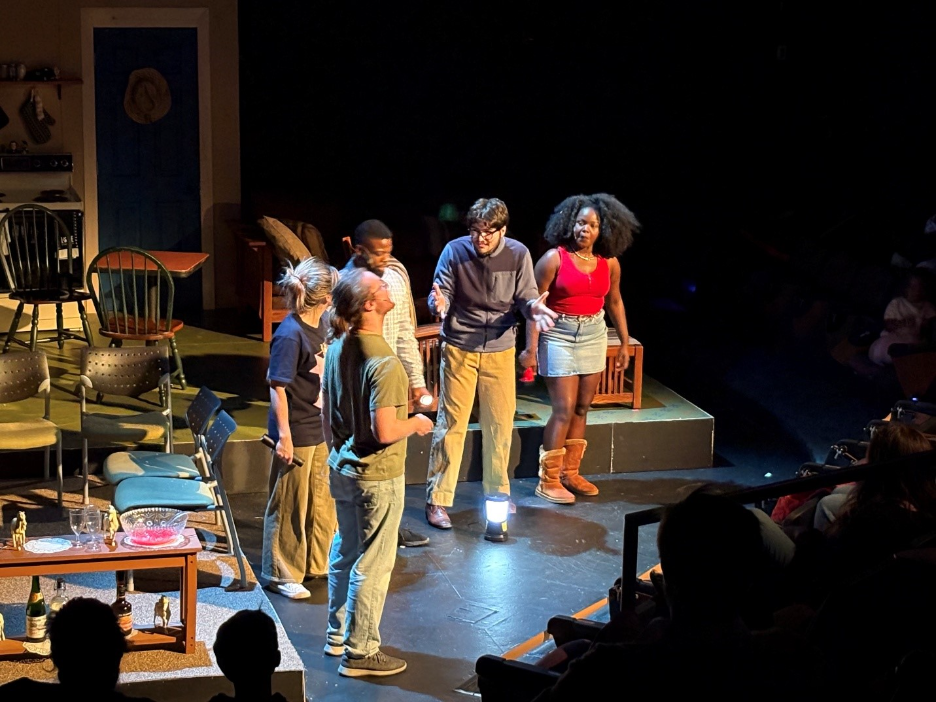
From Nov. 18–21, director and Professor of Drama Stephen Patrick Smith and his students put on a hilarious play written by local award-winning playwright Jenny Stafford. Originally produced in arrangement with Broadway Play Publishing Inc., NYC, “Beating a Dead Horse” is a farce comedy relying on absurd situations, rapid-fire dialogue, and ridiculous misunderstandings—and the actors truly made the challenging style seem natural.
The play itself, running about an hour and forty-five minutes long with a short intermission, was thoroughly enjoyable from the very start. Opening with the two main characters, Steve and Marty—brothers who have recently inherited their father’s animal funeral home—attempting to film a video for marketing purposes, audiences are immediately introduced to the unique contrast between the two brothers. Steve, played by Rinson Thomas, was empathetic and anxious, inheriting his father’s dedication to laying animals to rest with care. Marty, played by Josiah “Jo-Jo” Marker, was much less focused on the morals of their business, preferring to entertain by proposing outlandish ideas and adding amusement to their advertisement. The two are polar opposites, adding a layer of brotherly rivalry to the storyline. Both, and Marty especially, were incredibly animated, leaning right into the play’s theme of farce. Marker hit the mark on his character’s charm, leaving the audience wooed and topping off his performance by blowing a kiss after his final appearance.
Throughout the play, we see all the characters struggle with mid-life crises, keeping the play comical while adding a relatable layer for the audience. Nerrisa Ross as Erica, struggling in her career and love life, helped balance the irrationality of the storyline with situations an audience of young adults knows all too well. Kayla Frantz had a similar grounding role as Steve’s loyal 20-year partner, Bryony, keeping his irrationalities down to earth while capturing her character’s witty nature. Bryony held the crowd’s attention with her easy-to-like yet dynamic personality, suddenly switching from gentle to irrational and right back to calm during stressful moments.
The premise of the play itself was hilarious, keeping the audience guessing what could possibly come next. One of the most memorable characters had to be Todd, the floundering taxidermist. Cam Harris would burst through his friends’ doors with the newest project he picked up off the side of the road—Frankensteins of roadkill. Toward the end of the show, Todd delivered, in the most casual way, one of the most unexpected, climactic jokes of the show using one of his failed taxidermies, leaving the crowd in a frenzy of laughter and audible shock. In fact, the crowd erupted in loud laughter after nearly every punchline, proving the comedic genius of Stafford’s script.
“Beating a Dead Horse” wouldn’t have been the same without Kevin Lara and Katie Higgins, who played secondary characters yet nailed their roles as Marcus/Fritz and Marianne. Lara switched between his roles with so much ease that it took until the reveal for the crowd to realize Marcus and Fritz were played by the same actor—and his drunken funeral scene almost convinced us he was drinking on the job. Higgins was charming, full of poise, and nailed her character’s dementia, adding to the chaos and laughter from the crowd.
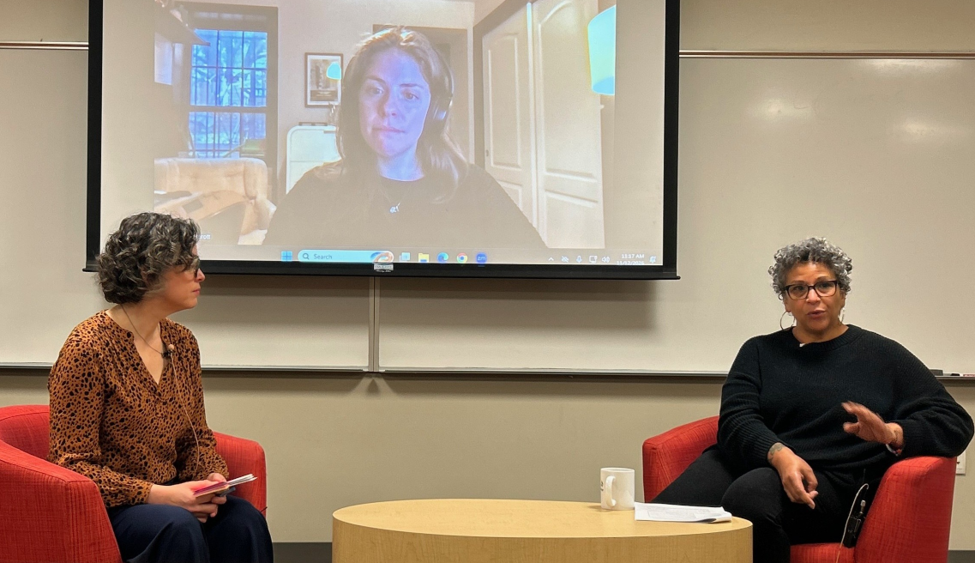
Before Thursday’s Nov. 19 performance, aspiring writers, actors, and theatergoers also got a closer look at Stafford’s process during a pre-show talk and Q&A. After a brief introduction to the play, Stafford answered questions from the crowd, providing honest, insightful answers. She opened up about her fear of failure as an artist, insisting that not only is it a part of the job she must accept, but that failure doesn’t mean anything about her as an artist.
“This is where I find a lot of my love and my identity, my heart,” Stafford shared. “[Failure and rejection are] just part of it.” When asked how she handles that rejection, she said she has to “feel really crappy for tonight, maybe tomorrow, and then I’m going to write something else.”
At times, Stafford needs to put a project away, though she rarely abandons one permanently. “This isn’t the right climate for this right now,” she told the audience. “If I’m still getting joy from it, it’s still worth it.” Following every well-thought-out answer, the crowd of DCCC students erupted in applause.
Stafford wrapped up her talk with a few more fun facts. Todd, the terrible taxidermist character in the show, was the one she found the most enjoyment in writing, and she shared her dream of producing a show on Broadway. Following a callout in support of her husband, sitting cross-legged in the audience observing his wife, Stafford mentioned his career as an organist for the Philadelphia Flyers. She finally thanked the audience and exited the stage to a roaring round of applause—surprisingly loud for the size of the audience, though well deserved for the quality of Stafford’s answers.
Behind the scenes, Smith, director of theater productions at DCCC and Philadelphia actor, calls himself “the musical jack-of-all-trades.” With students’ assistance, he builds the set while handling all matters of production for each play, including set design, sound, and lighting.
Having grown up an actor, Smith admires all forms of theater. After “Beating a Dead Horse” was recommended to him by one of his former students, he decided it would be a great opportunity to teach his students the comic genre of farce. He switches styles from play to play: “The more styles students understand, the more opportunities you’ll have as an actor,” he explained. Smith likes to teach farce because it’s fun, yet complicated and demanding, and he wants his students to be prepared when going into the acting world. “While this style seems effortless on the stage, it is a very demanding style of performance,” Smith detailed in his director’s note.
Overall, the play was a blast for the audience, proven repeatedly by their booming laughter and applause. The actors played their parts professionally, nailing each of their characters. The set design was particularly impressive—credit to director Smith—consisting of all the lived-in details you’d find in a struggling young adult’s apartment: diner menus and receipts on the fridge, half-opened cans on the stove, and paper cups instead of glassware. The entire team adapted Jenny Stafford’s “Beating a Dead Horse” with energy and humor, leaving the audience satisfied and out of laughter by its conclusion.



Leave a Reply