By Atefa Mahera and Aubrey Henson
On Thursday, Nov. 12, the Learning Commons hosted a Wikipedia Day event on Delaware County Community College’s Marple Campus in collaboration with Black Lunch Table. The event is the first of the year in the Learning Commons’ Next-Gen Digital Literacy Series, which is focused on empowering students with essential digital literacy skills through workshops and events.
Black Lunch Table (BLT) is a nonprofit history archiving project dedicated to sharing the stories of underrepresented Black artists through conversation, photography, archives and Wikipedia. As a free digital encyclopedia, Wikipedia invites volunteers around the globe to create and edit articles on notable subjects. BLT uses Wikipedia to address gaps in history and improve the representation of Black artists online.
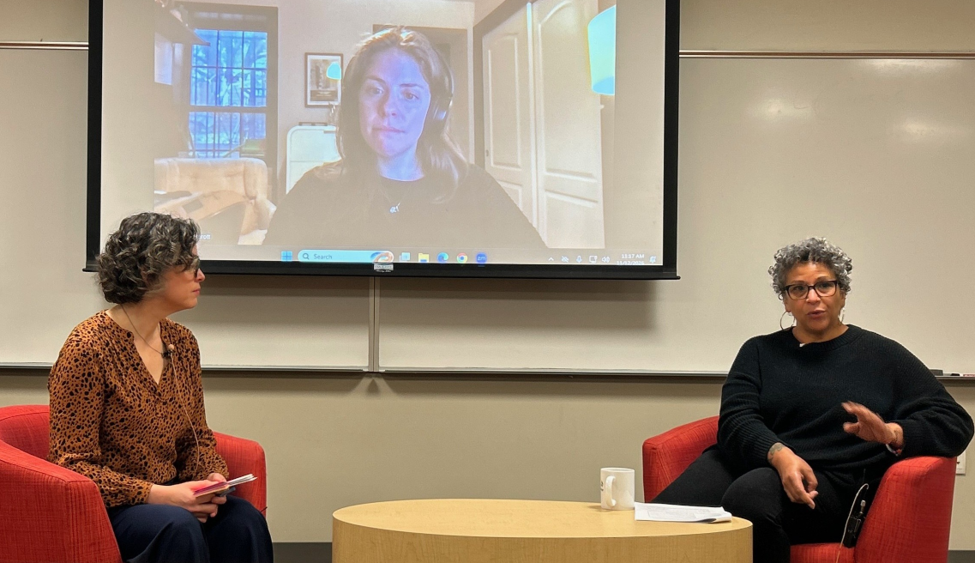
The Wikipedia Day event was broken into three hour-long sessions, beginning with a sneak-peek trailer screening of “Rabbit Hole” and a Q&A panel moderated by Learning Commons librarian Ellie Goldberg. Joining via Zoom was Meg Vatterott, who is debuting her first feature directorial project, “Rabbit Hole,” alongside Bridgette McQueen, interim executive director of Black Lunch Table.
“Rabbit Hole” is a documentary detailing the infrastructure and community behind Wikipedia. Vatterott, director, filmmaker and producer of “Rabbit Hole,” discussed her driving motives behind the film. Having experience in journalism, she was overwhelmed by the spread of misinformation online. She wanted to make a hopeful film with “interesting characters that will be fun to get to know.” Vatterott researched the community of Wikipedia intently and was surprised by their meticulousness.
“They have had conversations for years about the history of the Caesar salad!” she giggled. When asked why people might become Wikipedians —the volunteer editors who write and maintain Wikipedia’s articles—she suggested “it’s fulfilling to write about what you care about,” and encouraged involvement: “Truly everyone has something they can add to it.”
For DCCC student Nasirudin Robinson, watching the documentary shifted how he viewed a site he was once told to avoid.
“I have always been told that Wikipedia wasn’t a reliable source when I was younger, but from time to time I still find myself on the website due to the information you can find on the website about any topic you can think of,” Robinson said. He added that hearing how an Arab editor translated articles into her native language in 2008 made him reflect on “what life would have been like if she and other editors had never decided to be interested in Wikipedia.”
McQueen later joined the conversation. First, she discussed Black Lunch Table’s purpose and its partnership with Wikipedia. She explained that their goals are to share Black history and encourage Black artists, especially Wikimedians—contributors across Wikipedia and its wider family of free-knowledge projects, such as Wikimedia Commons. McQueen shared that out of more than 600,000 Wikipedians, roughly 3% are Black.
“The impact cannot be understated,” McQueen said about how the unequal demographics of Wikipedians affect the content and information shared. “The history of Black people is being erased,” she went on. “This is a way we can fight against that,” referencing the encouragement of Black Wikipedia artists.
The conversation also entered the subject of AI, and how it has and will affect the validity of information on Wikipedia. “AI is a big theme in the documentary,” Vatterott explained, noting how editors have already begun conducting research regarding AI on the platform. It was discovered that 20% of articles were AI-written, leading Wikipedia to ban them. “We’re at a pivotal moment,” she said, describing AI as “the greatest stealing of human labor.” She’s hopeful to see discussion surrounding regulations and lawsuits regarding AI.
DCCC student Abdul Sheikh, who attended via Zoom, said the discussion underscored why human editors remain irreplaceable.
“With AI, you are able to generate information at a rapid pace. However, just because you can doesn’t mean it’s accurate or factual,” Sheikh said. “Many of the contributors to Wikipedia take the time to ensure their information is accurate by providing citations and researching the subject.”
Approaching the end of the interview, Goldberg asked arguably the most anticipated question due to its nature of community: “What’s the value of Wikipedia to college students?” Vatterott and McQueen had almost identical answers. “Wikipedia is used to move information,” McQueen explained, encouraging students to use Wikipedia as an entryway, then move on to the sources. “Wikipedia gives an overview of the information,” Vatterott agreed, similarly recommending ending with the sources. According to the two, Wikipedia has a list of credible sources that is constantly discussed.
“Rabbit Hole” will premiere at a film festival in midwinter or early spring. “It’s still in the fine-tuning stage,” Vatterott explained. Following the premiere, the film will tour film festivals around the country. “We wanted [the film] to feel like falling down a Wikipedia rabbit hole,” Vatterott added, explaining the film title, which is still partly up for discussion.
The day concluded with a workshop titled “Become a Wikimedian: Join the Movement to Illuminate Black Artists’ Stories.” Led by Dylan Lewis, BLT’s public programs manager, the workshop introduced DCCC students to Wikipedia editing and how they can help preserve the stories of underrepresented Black artists in history.
Lewis opened the workshop by asking the audience to think about a Black artist, musician, filmmaker or creative whose work had stayed with them. Then they posed a question: “If someone searched for them 50 years from now, what would they find?”
They continued to state that while many Black artists have made significant contributions and hold immense talent, their work remains undocumented and risks being forgotten by future generations.
“We lose history all the time,” Lewis said, pointing to incomplete biographies and disappearing local newspapers. To address these gaps, Lewis encouraged students to become Wikimedians—contributors to Wikipedia and the broader Wikimedia community.
“Anyone can edit. Not everything can stay.”
Lewis explained that Wikipedia relies on guidelines to maintain the accuracy of its articles, and that a person’s popularity does not automatically translate to notability for a Wikipedia article. Articles must be supported by published sources that demonstrate the subject’s notability. They encouraged participants to consider how these requirements create barriers for artists who are lacking enough media coverage.
The workshop explored how Wikipedia contributions affect information beyond the site. Lewis explained that Google’s Knowledge Graph—which is the small blurb of information, including age and birthday, provided when you search up a notable person—and AI bots scrape from Wikipedia sites, meaning the information contributors add influences what people find when searching up individuals online or when using AI chatbots.
Lewis also touched on the benefits that come with being a Wikimedian. For one, active contributors who meet a set of criteria gain automatic access to the Wikipedia Library. The Wikipedia Library provides free access to publications and research sites often placed behind a paywall. Active contributors may also qualify for scholarships to attend Wikimedia conferences, which happen all over the world. Plus, students develop valuable digital literacy skills naturally as they learn to research, check sources and edit content.
The session concluded with a live demonstration of editing, using the Wikipedia article for David Drake, also known as Dave the Potter. Drake was an enslaved potter from the 1800s who became known for inscribing poetry onto his pottery.
The demonstration gave the audience an opportunity to see what editing on a Wikipedia article looks like, from using the wiki-specific code to creating a citation. “It’s a lot of copy and pasting,” Lewis laughed. They encouraged students to investigate Wikipedia, emphasizing that it is an enjoyable experience when done collaboratively.
For DCCC student Cynthia Wollie, seeing the human effort behind the platform stood out most.
“One aspect that seems amazing is that Wikipedia is maintained by volunteers, Wikipedians, and it is a nonprofit organization—people dedicating their time to ensure free and open knowledge is globally available,” Wollie said. “The overall takeaway from the presentation was the importance of inclusion across the globe and reinforcing diversity in art and sharing accurate information.”
For Goldberg, the event was an opportunity to help students and faculty better understand the platform. Goldberg explained that librarians often discussed Wikipedia with their students but cannot always investigate how it works. She also touched on the community-driven nature of Wikipedia.
“I think the community aspect of it is so fascinating, especially within the age of AI, where there’s so much alienation of people … This is something where people really come together, and I think it’s just a fascinating way to learn about how information is generated,” Goldberg said.
The three-session program was organized by Learning Commons librarians, with promotional assistance from DCCC’s art department. Two more digital literacy events are planned for the school year. The first is scheduled for Feb. 25, 2027, titled “The Data Rescue Project: Saving Data for the Public Good,” featuring a Q&A panel with Lynda Kellam, co-founder and director of the Data Rescue Project. The other event is scheduled for April 2027, when author Emily Hund of “The Influencer Industry: The Quest for Authenticity on Social Media” will visit DCCC.
Leave a Reply