
By Dominic DiIorio
Staff Writer
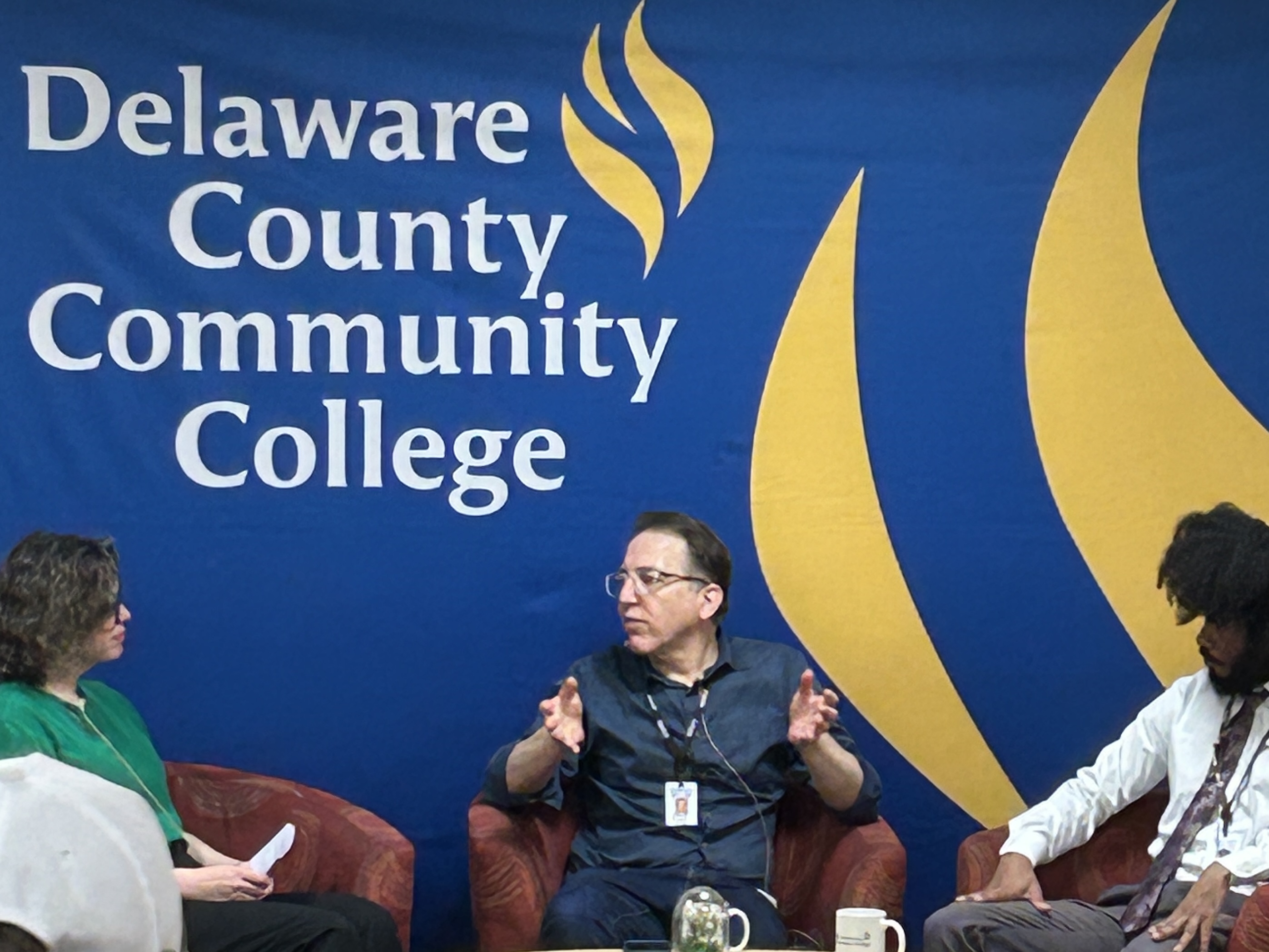
MARPLE, Pa.—Delaware County Community College recently hosted WHYY journalists Kenny Cooper and Meir Rinde for an in-depth discussion regarding the importance of modern journalism, local reporting, and the evolving media landscape. The event, moderated by librarian Ellie Goldberg, gave students insight into how reporters gather information, determine what is newsworthy, and navigate issues including bias, funding, and artificial intelligence.
Goldberg opened the event by introducing the purpose of the discussion. “We’re here today to talk with our two guests inside the newsroom, learn a little bit about what it’s like to be a journalist and what journalism looks like today,” she said.
Cooper, a multiplatform reporter covering the Pennsylvania suburbs, and Rinde, an investigative reporter for WHYY, shared their unique paths into the field. Cooper initially planned on becoming a teacher before shifting directions during high school after joining a media program. He explained that as he became more involved in school broadcasting, his interest grew, leading him to study journalism and political science at Temple University.
“I was planning on becoming a teacher up until junior year of high school,” Cooper said, adding that internships at major outlets such as CNN, NBC News, and Fox 29 helped shape his career.
Rinde described a similar early interest in journalism through student media. “I was editor of my high school newspaper, worked in my college newspaper and radio station doing news,” he said. Although he briefly considered academia, he ultimately chose to return to journalism because he wanted to work in “the real world, with all the daily news.”
Cooper provided a detailed layout of his daily routine, which starts early. He reviews news from multiple outlets and checks emails for press releases and updates. “I usually try to get up relatively early, around 6 or 6:30 a.m., just to see what other outlets are putting out,” he said. By midmorning, he typically has a pitch that has gained approval from an editor. “Usually by around 8 o’clock, I kind of know what I have planned for the day.” He noted that the stories he writes range from a few hours to several days depending on their complexity.
Rinde explained how journalists decide which stories to pursue, particularly those working on broader beats. He said reporters constantly evaluate their coverage areas for new or overlooked angles. “If you have a beat, then you kind of see what’s happening every day, and anything new that pops up, you’re probably pretty interested in covering,” he said. “I sort of look at all the stuff coming in and think, ‘Alright, here’s something that no one has covered and is interesting,’ or find a way to put a new spin on it.”
The major theme of the discussion centered on objectivity and fairness. Cooper emphasized that reporters must avoid inserting personal opinions into their work. “I always try to remind myself that I don’t have a side for a given story,” he said. He explained that his goal is to speak with as many sources as possible and accurately identify shared facts within disagreements.
Rinde reinforced this, stating that even if journalists have personal perspectives, they do not belong in news reporting. “Even if I did have a point of view… I’m not going to put that in the article,” he said. “It doesn’t matter what I think; what matters is getting the complete story out there.”
The conversation also addressed how WHYY maintains editorial independence as a nonprofit. Rinde explained that the organization is primarily funded through listener donations and underwriting. “There’s kind of a firewall,” he said, describing the separation between fundraising and editorial work. “There are people who deal with advertisers, there are people who deal with members and fundraising, and then there are reporters doing their job.” Cooper added that journalists do not interact with advertisers in their daily reporting.
Both speakers highlighted the importance of local journalism, especially in suburban communities that may not receive consistent daily media coverage. Cooper noted that each county has its own character and communication style.
“The people in Delaware County… they’re almost never friendly, but they will always talk,” Cooper said. He explained that residents are often direct and willing to engage once mutual trust is established. He also described how local journalism can influence civic engagement. “There is a lot of response to it, and that’s what you kind of want to see,” he said, noting that residents sometimes reference news coverage at public meetings.
Rinde added that WHYY produces practical, community-focused content, such as voting guides and informational resources. He explained that this type of reporting helps residents navigate civic processes and stay informed about their local communities.
The journalists also discussed the rise of social media and independent news creators. Rinde acknowledged that although these platforms can be valuable, they do not always follow traditional journalistic standards. “With startups and independent creators, they don’t necessarily have that tradition of impartiality,” he said.
Cooper encouraged students to evaluate news sources carefully, comparing reliable journalism to something made with “time, care, and attention.” He advised looking for basic elements: who, what, when, where, and why. “Does it have the basics… and can they back that up?” he asked.
Artificial intelligence was another major talking point. Rinde explained that AI tools are already being implemented in newsrooms for data analysis and document review, but he cautioned against relying on them for writing. “The articles are not that great… they’re like reading a press release,” he said.
Cooper expressed concerns regarding an over-reliance on AI, fearing it could weaken essential skills. “Those muscles begin to atrophy,” he said, referring to research and writing abilities. “Journalism is a skill… it’s a muscle that you have to work.”
As the discussion concluded, both journalists reflected on the role of journalism in government accountability. Cooper stressed the importance of attending public meetings to see what affects communities directly. “I will show up, and I just won’t see a lot of faces,” he said. “But I still think it’s important.”
Rinde added that journalists often serve as the only consistent observers of local government activity. “What matters is what happens next,” he said, emphasizing the importance of reporting outcomes clearly for the public.
The event ended with audience questions relating to truth, bias, and the future of the field. Rinde summarized the challenge: navigating an increasingly fragmented media environment while remaining willing to present complex issues through a fair lens. For students in attendance, the discussion provided a behind-the-scenes look at how news is produced and how careful reporting reinforces the foundation of public trust.
CORRECTION: The article previously misspelled Meir Rinde’s name as Mair Rindy.

Leave a Reply