By Dominic DiIorio
Staff Writer
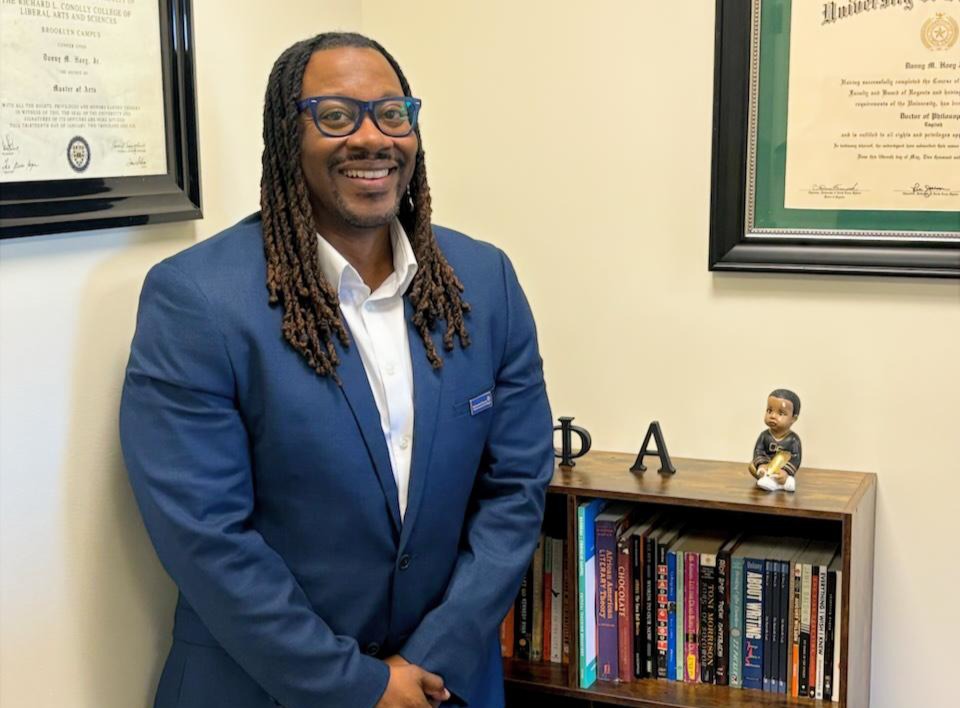
There’s a certain steadiness about Dr. Danny Hoey. You can sense an ease that naturally comes from him—someone who’s comfortable in his own skin and knows exactly who he is. When he speaks, it’s a speech of gentle tone filled with lessons and personal stories that fold into one another, making for a life teaching compendium. When you listen, it becomes clear that his life has been guided by a single throughline: purpose.
Danny M. Hoey was born and raised in the Collingwood neighborhood of Cleveland, Ohio. It’s a community that, as he puts it, “made me who I am,” with roots in both the Midwest and the South. His father came from South Carolina and his mother from Memphis, Tennessee. They met in Ohio, where Southern warmth met Cleveland’s grit. “My family is very Southern,” Dr. Hoey says with a laugh, “but we’ve got those Midwest R’s.” This cultural mix gave him a grounded view of the world—family first, faith in people, and a quiet belief in doing right by others.
When it came time for college, Dr. Hoey was determined to leave Ohio, yet fate had other plans. He ended up at The Ohio State University, where he found his footing within the ring of deep thinking and writing. From this point on, his academic path unfolded naturally. Each degree revealed the next chapter of his calling, with him earning a master’s in African American Studies from SUNY Albany, followed by another in English and Creative Writing. This was a deliberate step toward his goal: a Ph.D. in English, which he completed at the University of North Texas. Later, he pursued a postdoctoral fellowship at the University of Houston, teaching English and African American Studies while writing his first book, “The Butterfly Lady.”
“The Butterfly Lady” became one of the most personal projects of Dr. Hoey’s life. Set in Cleveland, it explores Black love, struggle, and the beauty and difficulty of belonging. “It was a really tough book to write,” he admits. “To write about home, to think about what it means to be Black in Cleveland—that was hard, but it mattered.” The novel serves as both a love letter and an act of reckoning to his past. It’s a reflection of the place that first taught him resilience.

Caption: Dr. Hoey speaking to a group of students and staff about his book and his writing philosophy at an event on campus last fall.
But even with the academic success, there’s another side to him—a side that dreams in sugar and flour. “I wanted to go to culinary school,” he laughs, “but my mother told me no.” If he could take any class just for fun, he says he would love to sign up for a baking course. He already knows how to ice a cake, but the artistry of decoration—the fondant and intricate designs—calls to him. “When I retire,” he adds, “I want to open a bakery.” You can almost see it: the warmth of the ovens and the smell of fresh bread, creating something that simply makes people happy.
The road into higher education wasn’t a straight one. His journey began with a moment that could have ended everything. As a freshman in college, Dr. Hoey was unfairly accused of plagiarism. A professor didn’t believe he could have written a paper with such advanced vocabulary. “She said I couldn’t use big words,” he recalls. “I told her, ‘I’m a reader. That’s where my words come from.’”
He faced serious disciplinary hearings and risked losing his scholarship over the accusation. “I felt alone,” he says. “But as I fought to defend myself, I realized I didn’t ever want another student to feel that way.” That moment became a turning point. He decided that whatever career path he chose, it would involve helping students advocate for themselves and making sure they were seen, heard, and believed.
Dr. Hoey’s career in academia blossomed into leadership roles that blended his love of education and his passion for equity. Before joining Delaware County Community College, he served as Provost of the West Campus at Valencia College in Orlando, Florida, and later as the Associate Provost for Academic and Student Success at the Community College of Philadelphia. When the opportunity presented itself at DCCC, he felt an immediate pull. Dr. Hoey says what drew him in was the leadership of President Dr. Marta Yera Cronin. “She and I were peers once, and she was also my supervisor early in my career,” he explains. “Knowing she would support me in doing meaningful work made me eager to join.”
Now, Dr. Hoey sits as Vice President of Student Affairs at DCCC. He leads not from behind his desk, but from the heart of the campus. “I go to things,” he says. “Student meetings, events, anywhere I can show up. I pop in, I talk to people. I don’t want to be the person students only hear about. I want them to see me, to know that I’m here to help them succeed.”
When asked about his goals, his answer is simple: relationships. “You can’t lead people who don’t trust you,” he says. “We can’t do the work without relationships. So, for me, it’s about building that trust, being a person of my word, and making hard decisions with kindness and grace.” He lives by a philosophy rooted in humanity. “You can make all the money in the world,” he says, “but are you happy? Are you having an impact? Are you living by your values?”
Dr. Hoey’s appreciation for community colleges runs deep. To him, these are spaces where people can make mistakes, grow, and still succeed. “Community colleges let students fail and recover,” he says. “We give them room to figure it out. That’s powerful.” He acknowledges that colleges face challenges, particularly in helping students finish what they start. “It’s not about ability,” he says. “It’s about life happening—jobs, family, finances. The real challenge is figuring out how to support those students through it.”
When asked about the kind of leader he strives to be, his response is shared with quiet confidence. “I lead with intention,” he says. “I’m clear in my expectations, kind in the execution, and I give people grace to make mistakes.” He is a believer in leadership that is developmental. “My job is to help people grow. If someone I’ve worked with moves on to a higher position, I see that as a success.”
He recalls a moment in college when he won “Mentor of the Year” after taking a struggling freshman under his wing. He promised the student’s parents he would look out for him. “I told him dropping out wasn’t an option,” he remembers. The student graduated and the two remain friends to this day. “Sometimes all someone needs is one person who won’t let them give up.”
As for his legacy at DCCC, Dr. Hoey wants to be remembered for how he helped people grow. “I want people to say, ‘He cared about us. He made us stronger.’” He wants to be remembered for the person he was—someone who taught others kindness.
“Kindness costs nothing,” he says. “But it changes everything.”
CORRECTION: In a previous version, the article incorrectly mentioned former DCCC President Dr. L. Joy Gates Black instead of the President Dr. Marta Yera Cronin.


Leave a Reply