
By Viviana Pruett-Saratan
Staff Writer
The cast members were all in costume. The mood was light as Gillian Keener sat in the center of the room, surrounded by a few of her castmates. It was performance night. Gillian and the other actors huddled in the classroom across the hallway from the backstage entrance to the auditorium. The room was filled with nerves and excited anticipation.

“Hey Gillian,” said her castmate Kevin Lara. “I have something for you.”
He held out his hand, revealing foam earplugs that he had been handing out to the cast for no particular reason other than silliness.
“Wow,” Gillian replied sarcastically. “Thank you.”
Everyone laughed at the gesture, which turned into inside jokes between the cast. The energy then evolved into Gillian rolling her wheelchair swiftly toward her friends in a lighthearted game of “chicken.”
“Five minutes till stage time,” said a stage crew member.
That meant it was time to warm up. The cast formed a circle around the room. Kevin began with vocal warmups; then Kayla Frantz, another member, led movement and grounding exercises. Gillian wiggled her fingers and scrunched her face, letting go of anxious feelings before going onstage. Finally, Kayla instructed them to hold hands and squeeze them one by one. The two people beside Gillian held her pinkies, and they all closed their eyes in silence. There was a sense of unity in the room. Everyone was relaxed.
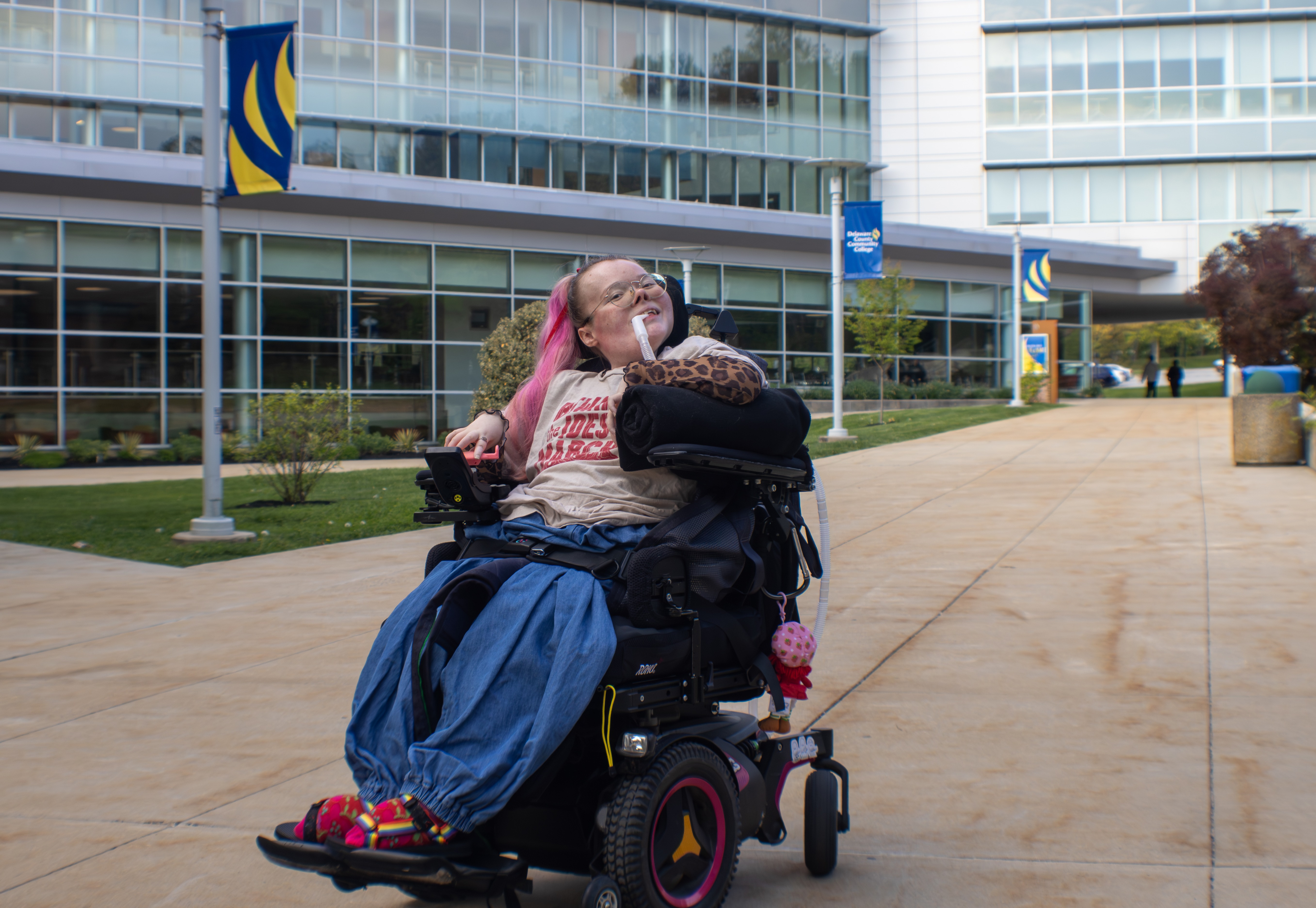
Pulling through the stage nerves of a performance is just one of many accomplishments Gillian has achieved at Delaware County Community College. This spring marks the end of her community college journey after three years of being a major part of the school. Apart from being a familiar face in theater, Gillian is a prominent member of the Phi Theta Kappa (PTK) honor society. You may have seen her traversing campus in her electric wheelchair, trailing a streak of colorful hair and fun, patterned sweaters.
Gillian approaches her disability as a fact, not a limitation. “I see [disabilities] as a neutral thing,” she said.
Gillian has Collagen 6 Congenital Muscular Dystrophy (COL6-CMD), a rare, progressive condition that affects muscle strength and mobility. Diagnosed at age 3, she has used a wheelchair since early childhood and now relies on breathing support and assistance with many daily tasks. Overall, she believes it is not something that should be considered negative or positive; it is simply what makes her who she is.
“If I didn’t have COL6-CMD, I wouldn’t be me,” she said. “A world without variation would be pretty boring.”
Due to her disability, participating in certain activities can be challenging, but it does not stop her from achieving her goals as an outstanding student. As a well-loved member of PTK, Gillian has served as vice president, president, and ambassador of advocacy during her time at DCCC. As an officer, Gillian emphasized the importance of understanding individuals to better work with them.
“PTK gave me the space to try to get to know people and understand them,” she said. To Gillian, PTK wasn’t just leadership; it was camaraderie. “I think that is the best way to learn how to be a leader. Learn to understand the people that you are working with…then I think it makes for a better team.”
A star student, Gillian works diligently to maintain high grades. Her hard work has paid off; through PTK, she was recognized for her dedication by earning a spot on the All-Pennsylvania Academic Team. The scholarship program nominates community college students from across the state with high academic achievements and leadership skills. The award guarantees Gillian two years of full tuition at any university within the Pennsylvania State System of Higher Education. She, along with eight other DCCC students, received the award in Harrisburg on April 7, 2026.
“It made me feel more confident in myself and my skills,” Gillian said.

Naturally, her academic achievements did not come without struggles. When Gillian first began her college journey, she had doubts about her ability to succeed. Because of her disability, it takes her longer to complete assignments than the average student. To maintain a healthy school-life balance, Gillian takes three classes at a time to protect her mental health and ensure she has the time to create quality work.
She advocates for herself, knowing her limits while striving for excellence. One example involved an online course where she was required to submit handwritten notes. Because writing is a difficult task for her, she emailed her professor requesting to type her assignments. The professor initially directed her to Disability Services. However, during the next class held on Zoom, the professor saw Gillian’s physical limitations on camera and messaged her in the chat to grant the request.
“I guess he didn’t believe I was disabled,” Gillian said with a giggle. Despite the situation, she holds no bitterness, laughing it off as a funny story. “Anyone else would probably have been annoyed, but I just thought it was funny.”
During a stagecraft class, Gillian and eight other students were assigned to draw their faces in a mirror to practice makeup skills. Since Gillian is unable to hold a pencil, she had help from her older sister, Emily, who along with their mother, serves as one of Gillian’s aids. When the drawing became difficult, Gillian’s friend, Rincon Thompson, came to the rescue. It was a team effort: Gillian described her face, Rincon drew, and Emily provided feedback. The class was full of giggles as they worked under the guidance of Professor Stephen Smith. Rincon drew her in great detail, even adding a tiny wheelchair as a final touch.
“Looks good,” Professor Smith said with an approving nod.
Gillian takes the lessons from her theater classes directly into her college performances. During the fall 2025 semester, she starred in “The Curious Incident of the Dog in the Night-Time” as Siobhan, the primary teacher and narrator who guides the protagonist through his struggles on the autism spectrum. This was the largest role Gillian has held at DCCC, following minor roles in “Romeo and Juliet,” “Airness,” and “Into the Woods.”
Gillian admitted that playing a lead was intimidating at first. “I was afraid I would disappoint everyone, including myself. And I was especially terrified of memorizing all those lines!” she said.
Professor Smith praised her for being the first to memorize her lines and for a work ethic that set an example for the rest of the cast. “She is also extremely intelligent and able to create a character, follow direction, and memorize lines quickly,” he said.
When it was stage time, Gillian rolled up the ramp with confidence. As the lights dimmed, she entered her “acting zone,” shifting into character through her tone of voice and vocal expression. Her ability to use a clear British accent was a highlight of the performance. Though she is in a wheelchair, her movements on stage were intentional and dramatic, from a subtle turn toward the audience to a slow, meaningful roll across the stage.
Gillian credits her family for her confidence and her comfortable mindset regarding her disability. Her parents attend every theater performance and PTK social event.

“We’re so proud of her and everything she has done,” said Gillian’s mother with a beaming smile.
Her older sister, Emily, acts as Gillian’s aide on campus, attending classes, rehearsals, and meetings. Despite the role, Emily and the rest of the family recognize that Gillian deserves her independence. Emily provides the space Gillian needs to succeed while being ready to help when needed.
“I definitely think there has been a big change in how outgoing she is,” Emily said of Gillian’s growth.
Gillian replied with her signature humor: “I’m now a menace to society.”
Gillian will graduate in May 2026 with an associate degree in liberal arts. While she is still deciding on her next school, she plans to study philosophy or sociology at a four-year university. During her final semester at DCCC, she is co-directing “Avenue Q” and hopes to continue directing part-time in the future. Her experience at Delaware County Community College helped her grow into an admirable leader and redefine what it means to live with a disability.
“I hate the trope of, ‘If you’re disabled, there’s nothing out here for you,’” she said. “Coming here showed me that there is so much more out there. Not just related to disability, but in mindset.”
Photography contributed by Viviana Pruett-Saratan, Emeliano Villagomez-Lopez, and Stephen Smith


Leave a Reply