
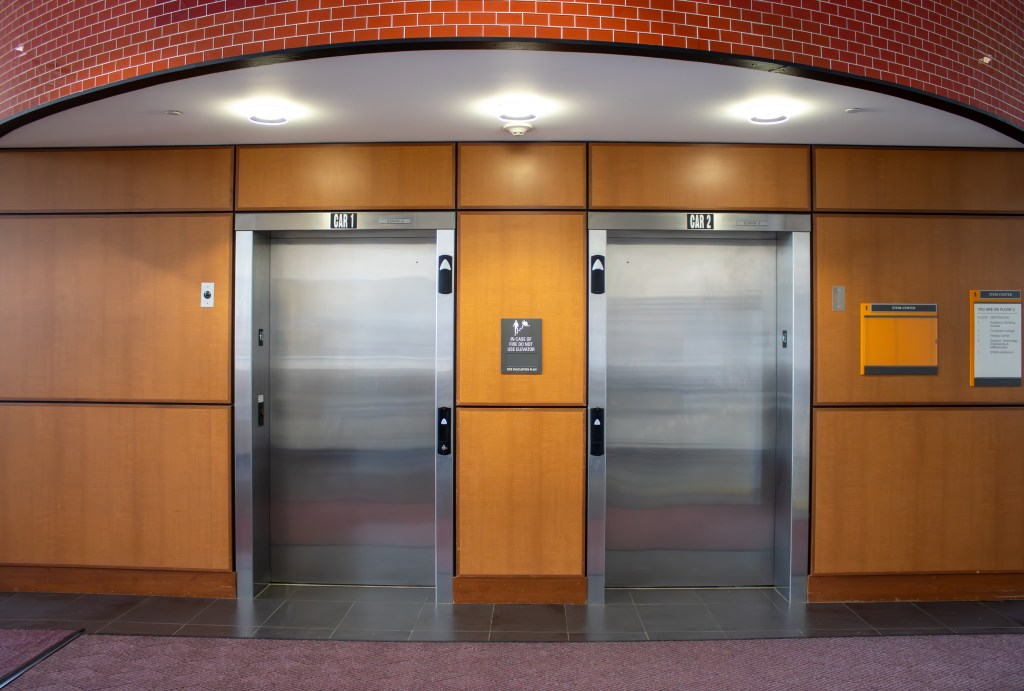
By Dominic DiIorio
Staff Writer
There are very few places on Earth that are more socially complex than an elevator. No, it is not international diplomacy, nor is it those chaotic “ladder match” Thanksgiving dinners between questionable family members you haven’t seen in years. I mean, not even those group projects where one person does all the work while others disappear and then come back to say, “Just tell me what to do,” can even come close to the iron box.
True human behavior is exposed in the confines of an elevator that travels vertically at a speed just slow enough to make you question time, reality, the universe, and life itself. Delaware County Community College is no different and certainly has its ups and downs (sorry, I had to do it).
Like anywhere else in the world, DCCC elevators provide their own unique experience and necessary etiquette. They’re not just transportation devices; they are social experiments that make you feel like a lab rat waiting for something to hit the fan. They test everything about your personality—quite frankly, they are UFC mental arenas where the human spirit is tested between floors two and three.
Let’s begin with the crown jewels of DCCC: the four elevators in the Academic Building. These are definitely the best to use during the day. They’re kind of the Harvard of elevators; they usually have no stops, pauses, jerks, or weird sounds that make you question the probability of going airborne as the carriage barrels toward the ground. They’re the reliable option (mostly).
Every elevator is always filled with a rotating cast of characters. It makes you feel like you’re on a sitcom, but instead of becoming familiar with their names in the intro, you don’t know what the heck they are called. We choose to pretend we don’t see each other even when standing approximately three inches apart, as if we’re in a political debate where acknowledging the other person could accidentally lead to a real conversation.
The full spectrum of human behavior is on display. Every character is unique: from the button-mashing enthusiast who thinks pressing the button 17 times will launch them into the stratosphere like they’re on a NASA mission; to the silent philosopher who stares at the floor or ceiling for too long, thinking these areas hold the meaning of life; or even the “silent yet deadly” agent who quietly turns that box into a tear-gas test zone. These individuals are always there, making their appearances at DCCC.
Now we move to the lone elevator in the STEM Building. This elevator is less of a convenience and more of a test of one’s patience. It operates on what scientists call the “I don’t know, just wait and be quiet” theory. Sometimes it arrives immediately; other times it makes you reconsider taking the stairs like you’re training to fight Apollo Creed. You might even get the urge to change majors or transfer schools entirely, but it’s important that you remain calm because it does eventually arrive. Just be prepared to feel like you’ve been waiting there for years. Maybe look in a mirror later that day to make sure you didn’t grow a beard or double-check the year. There is no way of proving the STEM Building elevator can freeze time, but maybe it could come in handy if you’re late to class?
Finally, we have the two elevators in Founders Hall. Or one elevator? No, two. There is no way of knowing because many at DCCC forget these elevators exist. However, if you do end up using them, they are a “chaotic neutral” choice. They are more unpredictable than the economy, slightly mysterious, and often crowded with people who suddenly develop an intense interest in their phones the moment the doors close. If you see someone else on the elevator before you, it’s genuinely startling—almost like seeing a ghost.
This is where elevator etiquette becomes less of a guideline and more of a survival skill. I’m talking about the rules. Not the written rules—there are none. I’m talking about the deeply ingrained, universally understood (yet constantly violated) code of conduct. Whoever is the constant disruptor in elevators, please read the following carefully:
Rule #1 – The Floor Button Is Not a Stress Ball: Press it once. That’s all that is required and that’s the agreement you’re making to society. Repeatedly jabbing it like you’re trying to wake it from a coma doesn’t make the elevator go faster. It just tells everyone that you belong in a straitjacket. We know you’re in a rush. So are we; just calm down. The elevator already knows you’re there, and it’s just choosing when to acknowledge you—much like you do when you ignore tax deadline emails from the IRS.
Rule #2 – The Door Close Button Is a Fallacy: That door close button is only there as an illusion. Stop trying to press it with urgency like you’re preventing a tornado from getting in. The elevator door always closes when it feels emotionally ready, and you need to be aware of that. The button mainly exists to give you the comfort that you are influencing events, which is also the basic premise of college. Just relax. The door will close, and if you change your mind and need to let someone else in, put your hand out and stop it.
Rule #3 – The Silent Agreement: The moment those doors close, it is important that you enter a quiet state just like everyone else. Understand the mutual understanding: we will not speak, we will not connect, and we will pretend none of this is happening. No one needs or wants to hear the entire recap of your day. A simple “how you doing?” is fine, but if you actually dive into how you’re doing, I don’t think you’re human. Just acknowledge, smile, and stand there facing forward like you’re in a very boring criminal lineup.
Rule #4 – The Exit Strategy: If you’re near the door, realize that you are now part of a very important system. You need to step out immediately when it opens for your floor—not because you want to, but because you must. It’s a small, silent sacrifice for the greater good of the flow of people coming on and off. Getting off slowly is the social equivalent of watching someone hold up the line at the DMV while they hum an annoying tune. Just be better.
Rule #5 – The Backpack Awareness Program: In normal life, your backpack is just a bag. However, in an elevator, it becomes a major liability. If the backpack is full, it increases the weight and the impact if someone gets caught in its line of sight. One careless turn and you’ve knocked three students unconscious because of your heavy textbooks. Suddenly, you’re a hazard and the villain of a very boring, elevator-themed movie. Hold it, control it, or take the stairs.
And yet, despite all the awkwardness, the unspoken rules, and the occasional mechanical hesitation, there is still something strangely beautiful about the elevator experience at DCCC. We all have the same internal questions: Is this the same person from my class, and do I acknowledge them or pretend we’ve never met? Should I have taken the stairs? Am I standing too close? We all share the same thoughts in that brief moment. It is an odd social setting that unites everyone. It’s a place where everyone, regardless of major, background, or caffeine intake, shares the same goal: to get from one floor to another without having odd interactions. In a world that forces us into constant connection, it’s funny to have elevators. It’s one of the very few social settings that offers a brief, glorious, awkwardly fun escape. It’s a moment of silence. A shared understanding. A temporary pause between destinations. Annoying, yes, but necessary.
So, the next time you step into one of the Academic Building’s elite elevators, or you find yourself waiting patiently (or not so patiently) for the STEM Building’s lone warrior, remember this: you are not just riding an elevator. You are participating in one of the most complex, unspoken social rituals of college life. And if you press the button more than once… we all notice.


 The Communitarian
Leave a comment