
By Viviana Pruett-Saratan
Staff Writer
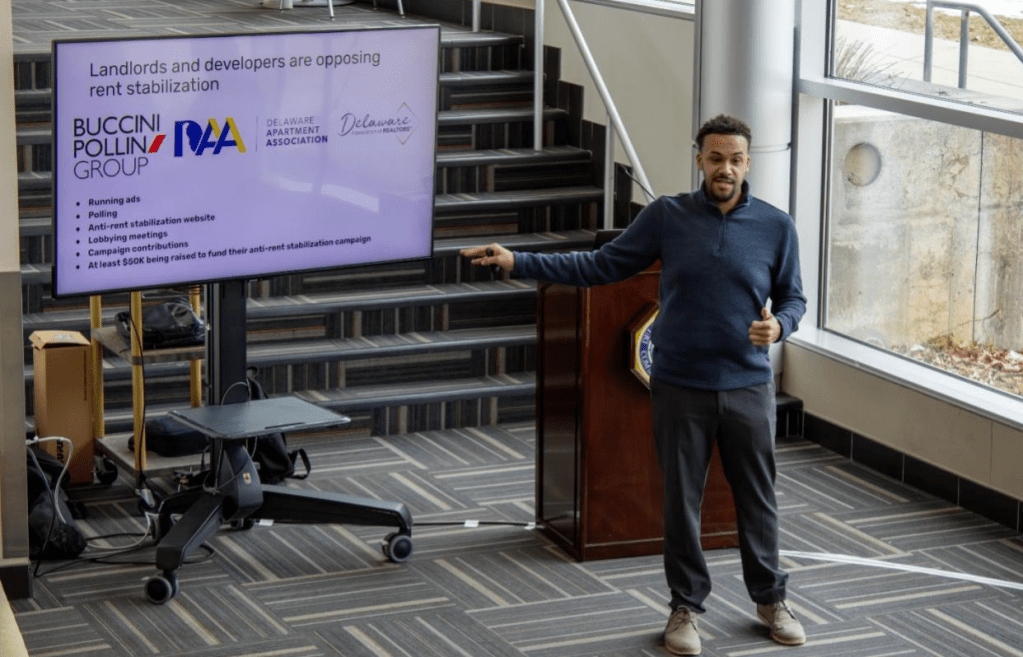
MARPLE, Pa.— On Thursday, Feb. 19, 2026, the Office of Institutional Equity hosted a Women’s Empowerment Initiative meeting featuring community organizer and advocate Branden Fletcher. Fletcher gave a 45-minute informational presentation on the housing and rental crisis, as well as advocacy initiatives across Wilmington, Del., and Delaware County, Pa.
The presentation began with an introduction from sociology professor Dr. Adriana Bohm, who welcomed Fletcher to the stage. Bohm first met Fletcher at Red Clay School Board meetings when he was 18 years old, where he would listen to discussions and speak up about educational policies.
“I was inspired by his advocacy and activism,” Bohm said. “I then watched him get involved in voting rights and rent stabilization. I read a book called Eviction and knew this was a critically important topic. As such, I asked Branden to come speak.”
Bohm explained that the housing crisis is a vital issue for women’s empowerment. “This issue speaks to women’s empowerment because women are the ones most commonly evicted, especially young mothers with children,” she said.
Fletcher, 25, works as a campaign manager for voting rights with the American Civil Liberties Union of Delaware. In 2020, Fletcher helped launch the HOMES campaign, which stands for “Housing, Opportunity, Mobility, Equity and Stability.” The housing justice advocacy group works on behalf of homeowners, renters, people who are unhoused, and those returning from prison.
Fletcher explained that due to a spike in luxury housing and gentrification, rent and evictions have increased at an unprecedented rate. Newly developed luxury housing in once-affordable neighborhoods is often priced between $2,000 and $3,000 a month, while the minimum wage remains at $15 an hour. Fletcher noted that to afford such housing, the minimum wage would need to be approximately $26 to $30 an hour. As a result, many in his community have struggled to pay rent or have faced eviction.
“You don’t need to be a public policy expert to know the challenges that are happening in your community and to organize your neighbors to move to change these challenges that exist,” Fletcher said.
He discussed one specific project within the HOMES campaign titled “The Rent Is Too Damn High.” For this project, Fletcher and other community members listened to residents’ concerns and sought to address them through policy change. To date, the HOMES campaign team has sent 145 letters, 2,657 emails, and 600 petition signatures to policymakers, in addition to canvassing and “bird-dogging”—following candidates to question them on their positions—to fight for reform.
Fletcher emphasized that housing advocacy is not limited to one region. “The principles of advocacy—talking to neighbors, identifying the problem, and moving to change them—can apply anywhere, whether you’re in Philly, Delaware County, or Media,” he said.
Another initiative Fletcher highlighted was the City of Wilmington Autonomous Tenants Union. The tenant-led union advocates for housing justice by giving renters a voice and upholding their rights. The organization coordinates community members to respond collectively when rent is raised or other housing challenges occur, allowing them to make demands as a unified group.
Following his overview of the campaigns, Fletcher showed a video highlighting the housing crisis across the United States. The footage followed a woman in Kansas City whose rent was rising despite a lack of basic safety and stable electricity. The video explained that certain development companies and policymakers exploit property owners and renters but also showcased organizations like the HOMES campaign that are fighting back.
In the video, one union member described their success: “We have written and passed a tenant’s Bill of Rights. We have won free lawyers for every tenant facing eviction. We’ve organized buildings and recently just elected four city council members.”
“That’s kind of what we need right now in our community,” Fletcher said after the video. “And we have that ability to organize and push for change.”
During the Q&A session, an audience member asked if the recent developments in Delaware County would affect local rent prices.
“Absolutely,” Fletcher replied. “If you’re seeing all this development and you’re seeing rents continue to go up, it’s time to consider other alternatives to address the housing crisis. You should probably start talking to your county council or city council, or whoever governs your local rent stabilization.”
Following the discussion, attendees were invited to ask further questions and enjoy food provided by the Office of Institutional Equity.
“I hope students realized that there is a movement fighting for dramatic change like affordable housing, rent stabilization, and livable wages in our community, and that it is everyday people standing up to challenge these injustices,” Bohm said after the event. “Students should know that they can get involved and fight for change, too.”

 The Communitarian
Leave a comment