
By Luis Herrera-Herrera
Staff Writer
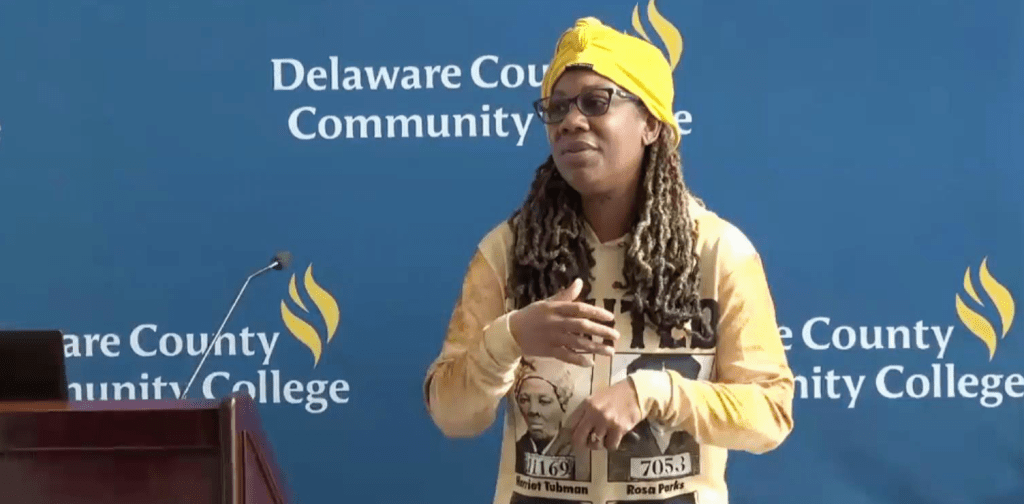
MARPLE, Pa. — Seventy-two years after the landmark Brown v. Board of Education decision, the legacy of desegregation remains a vital—and often misunderstood—part of the American landscape. Professor Keeley Mitchell explored this history and its modern implications during a “Dialogues for Opportunity” session on Feb. 26 at Delaware County Community College’s STEM Building.
The event was hosted by the Office of Institutional Equity as part of the college’s Black History Month observances. In a statement to the community, Dr. Momodu Taylor, Vice President of Institutional Equity, emphasized that such sessions offer “valuable opportunities to learn, reflect, and engage with the rich diversity of experiences, histories, and contributions that shape our society.”
Mitchell, who holds a law degree from Georgetown University Law Center and an MBA from the Pennsylvania State University, partnered with Taylor’s office to examine the legal and social strategies used to overturn the “separate but equal” doctrine of Plessy v. Ferguson (1896).
In addition to the anniversary of the 1954 Supreme Court decision, Mitchell noted that 2026 marks “100 years since Dr. Carter G. Woodson started Negro History Week” and the “50th anniversary this year of Black History Month, which was implemented by President Gerald Ford.” Mitchell explained that Negro History Week began after Woodson, while at Harvard, overheard a historian denying the existence of Black American history.
Leading the discussion, she introduced Thurgood Marshall, the lead lawyer who argued the Brown v. Board of Education case. Mitchell highlighted Marshall’s enduring legacy as a civil rights attorney, noting his local ties to the region as an alumnus of Lincoln University.
Mitchell shared that Marshall was first introduced to the U.S. Constitution as a form of punishment by his high school principal for delinquency. Later, after being rejected from the University of Maryland due to his race, Marshall successfully sued the school to challenge its admission policy. He also worked with the FBI and helped draft the Kenyan constitution.
Mitchell highlighted two significant quotes from Marshall. The first: “Where you see wrong or inequality or injustice, speak out, because this is your country. This is your democracy. Make it. Protect it.” The second: “I wish I could say racism and prejudice were only distant memories. We must dissent from the indifference. We must dissent from the apathy. We must dissent from the fear, the hatred, and the mistrust. We must dissent because America can do better, because America has no choice but to do better.” Mitchell noted how influential these words remain today.
To provide context for the 1954 decision, Mitchell discussed Plessy v. Ferguson, the case that instituted the “separate but equal” doctrine. During the Jim Crow era, Black Americans were legally barred from attending the same schools as white Americans.
“In a 7-1 vote, the court ruled that segregation of public facilities did not violate the 14th Amendment’s Equal Protection Clause,” Mitchell said. “And the idea was, even though they were separate facilities, they would be treated equally.” The lone dissenter was John Marshall Harlan, who argued that the Constitution should be “color-blind.”
Brown v. Board of Education of Topeka was a compilation of cases coming from Kansas, South Carolina, Virginia, Delaware, and Washington, D.C. Through sociological methodology, the court overturned Plessy and called for the desegregation of schools, though implementation was not immediate. Mitchell noted that in some instances, states like Virginia resorted to shutting down all public schools to prevent integration.
In Pennsylvania, desegregation began on buses in 1867. By 1881, a state law allowed Black children to attend public schools, though they remained largely segregated. In 1935, Pennsylvania passed laws protecting civil rights and outlawing racial discrimination. Mitchell highlighted a significant timeline for local desegregation: “1968 is when Pittsburgh School District is officially desegregated. 1971 is Philadelphia desegregated. So there’s a huge gap from 1954 to 1971.” Today, a 2022 study suggests schools remain functionally segregated in some areas due to the legacy of redlining.
Mitchell also discussed the 14th Amendment, which was necessary to grant citizenship to formerly enslaved Americans following the Dred Scott case. This history connects to modern debates, Mitchell argued, as various groups use the Equal Protection Clause to gain civil rights.
“We’re seeing attacks on diversity, equity, inclusion, and belonging—this idea that if you include everyone, you’re discriminating,” Mitchell said. She reminded the audience that many who supported segregation are still alive and active in society. Mitchell also pointed to Palmer v. Thompson, a case where public pools were closed to avoid integration. “So, if you hear the stereotype, ‘Black people don’t swim,’ it’s because public pools and access for swim lessons were closed.”
Concluding the event, Mitchell expressed concern that many current students are disconnected from this history. “Students just don’t have the history anymore,” Mitchell said. “There were three students there, and I said, ‘Do you even know any of this?’ and they said no.”
Mitchell stressed that understanding the country’s history is essential to navigating difficult conversations—like those she encountered in law school when peers would ignore historical barriers while telling others to “pull themselves up by their bootstraps,” ignoring the fact that people were actively being prevented from doing so.

 The Communitarian
Leave a comment